


Many Bangladeshi students dream of more than a degree. They want to build a life abroad: real work experience, a stronger income, and for many, a place to settle for good. Here is the encouraging truth. For almost every kind of student, there is a realistic route. You do not need to be the perfect applicant with a perfect profile. You just need to know your strongest card, and choose the country that rewards it. This guide helps you find yours.
Staying abroad happens in two simple steps
A study visa is your starting point, not the finish line. Settling permanently usually happens in two friendly steps.
First comes a post-study work permit. After you graduate, most top countries let you stay and work for a while, often for any employer. This is your runway to gain local experience and find your feet.
Then comes permanent residency, or PR. This is a separate application, judged on things like your job, your income, your language ability, and your age.
No country hands out PR automatically. But many make the journey very doable, especially when you play to your strengths. So let us find yours.
If you are young, your age is a golden ticket
Some of the biggest destinations use points-based systems, and they reward youth generously. The younger you are when you apply, the more points you begin with.
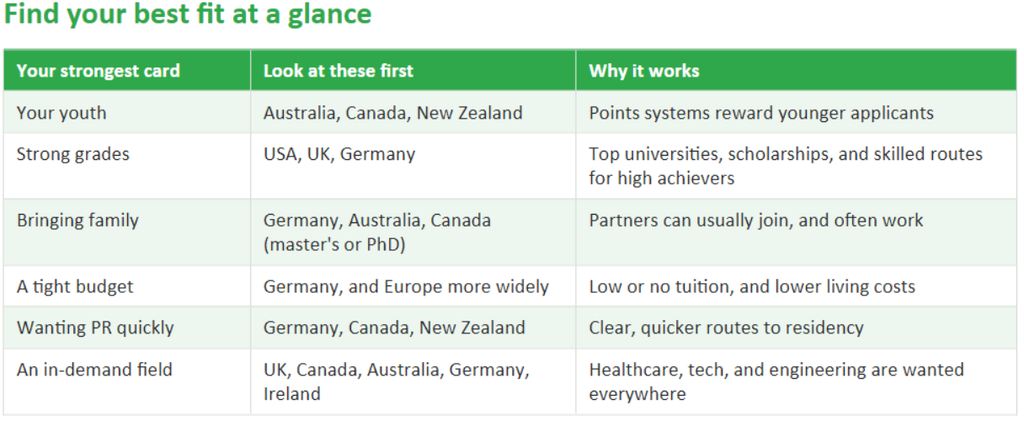
If you are in your early or mid twenties, look first at Australia, Canada, and New Zealand. Australia favours younger applicants strongly and expects most graduate visa applicants to be 35 or under. Canada and New Zealand also give real weight to age in their skilled residency systems.
The lesson is simple and hopeful. Going earlier is a genuine advantage, so if age is on your side, use it.
If your academic results are strong, aim high
Strong results open doors that stay closed to others: better universities, more scholarships, and the most rewarding stay-back options.
Look first at the United States, the United Kingdom, and Germany. In the US, graduates in science, technology, engineering, and maths can work for up to three years after study, which gives several chances at a skilled work visa. The UK pairs strong, respected universities with a graduate work visa. Germany actively welcomes qualified graduates through its fast Blue Card route. And truly outstanding students have extra US options that skip the usual queue altogether.
If you have worked hard for good grades, let them carry you.
If you are bringing your family, choose a family-friendly country
Family rules have tightened in some places and stayed generous in others, so this choice matters more than it used to.
Right now the kindest options for families are Germany and Australia, where your partner can usually join you and, in many cases, work. Canada is also strong if you study at master’s or doctoral level, because your spouse can often get an open work permit too.
One tip helps almost everywhere. Studying at master’s or PhD level greatly improves your family’s options across most countries. And a gentle heads-up: the UK now allows only PhD and research students to bring family, so plan around that if the UK is your goal.
If your budget is tight, Europe is your friend
A smaller budget does not close the door. It simply points you toward smarter destinations.
Germany is the standout. Many public universities charge little or no tuition, and after you graduate you can take any job while you search for a role in your field, which eases the pressure. More widely, studying in Europe is often far cheaper to begin a stay in than the UK, the US, or Australia.
Spend less, and still build a future. That is a very good deal.
If you want the fastest, clearest path, keep it simple
Some routes are simply more straightforward than others.
For speed, Germany is hard to beat. With some German language ability, permanent residence can come in around two years of skilled work. For a clear, well-established pipeline, Canada is excellent: graduate, work for about a year in a skilled job, then apply through Express Entry. New Zealand is getting faster too, with recent reforms reducing the work experience needed for residence.
If certainty matters most to you, start with these.
Whatever your field, being in demand is the biggest advantage of all
If your subject is in high demand, almost every door opens wider. Skills in healthcare, engineering, information technology, and the skilled trades are wanted in the UK, Canada, Australia, Germany, Ireland, and beyond.
So if you are still choosing a course, remember this: a field the world needs is the single strongest card you can hold.
A quick word on language
If English is your strength and you would rather not learn a new language, you have plenty of choice. The UK, Canada, Australia, New Zealand, Ireland, and the US all study and work in English.
If you are open to learning German, Germany rewards you with one of the fastest and most affordable routes to settling of all. Either way, you are not stuck.
How OptiMA Study Abroad Solutions can help
Finding your strongest card, and the country that rewards it, is exactly what our counsellors do every day. At OptiMA Study Abroad Solutions, we start with your real profile: your results, your age, your budget, your family plans, and your field. From there we map the destinations where your chances are genuinely strongest, so you aim where you are most likely to succeed.
We also keep pace with the rules, which in this area change faster than almost anywhere else. When a country updates its graduate work or residency policy, even while your application is already in progress, we adjust your plan so it stays current instead of going stale.
And we stay honest with you. We will gladly show you where a realistic path to settling exists, and we will tell you kindly when a particular route is not the right fit. A decision this big deserves clear facts and a plan built around you.
The bottom line
The dream of studying abroad and building a life there is real, and for the right student in the right country it is very achievable. The trick is not to be strong at everything. It is to know your best card and lead with it.
So play to your strengths, choose with current facts, and be a little cautious of anyone who promises guaranteed residency, because that is one promise no honest adviser can make. Do that, and the road ahead is far more open than it may feel today.
And remember, whatever you decide, coming home with a respected degree and real international experience is its own kind of success. You have more good options than you think.
A note on accuracy: the rules and figures in this article are current as of September 2026 and are drawn from official sources, including the UK Home Office, Immigration, Refugees and Citizenship Canada (IRCC), the Australian Department of Home Affairs, US Citizenship and Immigration Services, Germany’s Make it in Germany service, Immigration New Zealand, and Ireland’s Immigration Service Delivery. Post-study work and immigration rules change often, and several are being reformed right now. This article is general information for planning, not immigration or legal advice. Always confirm the current rules for your destination, and seek qualified advice for your own situation, before making any decision.
Last reviewed: September 2026.